
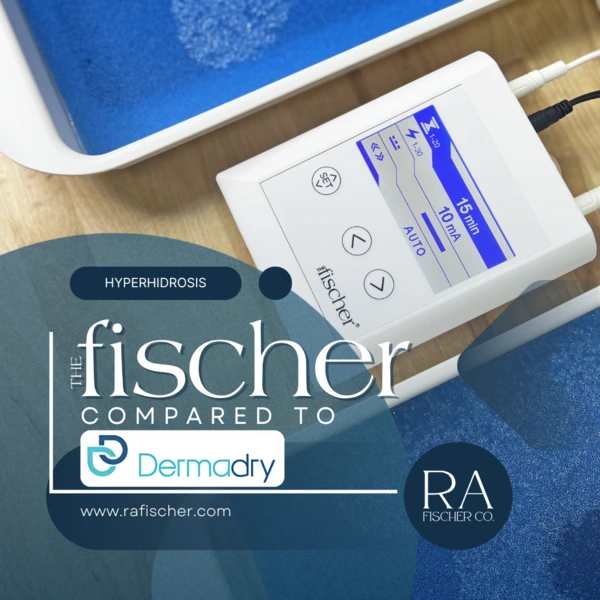
The Fischer vs. Dermadry®: Which Iontophoresis Device Is Right for You?
If you’ve been diagnosed with hyperhidrosis and your dermatologist has recommended iontophoresis, you are probably comparing two devices that come up frequently: The Fischer and Dermadry®. Both are FDA-cleared, both treat hands, feet, and underarms, and both use electrical current through water to reduce sweat gland output. The differences in electrode design, current modes, treatment flexibility, and insurance support make a meaningful difference for long-term results.
Quick Verdict
The Fischer is the stronger choice for most people dealing with hyperhidrosis. It offers fully adjustable current from 1 to 30 mA, both Direct Current and Pulsed Current modes, superior foam-based electrode protection, the ability to treat hands and feet simultaneously, and insurance assistance handled directly by RA Fischer Co., a company that has specialized in iontophoresis since 1948. Dermadry® offers only Pulsed Current mode and cannot treat hands and feet at the same time, meaning combined treatment takes roughly twice as long.
Feature-by-Feature Comparison
| Feature | The Fischer | Dermadry® |
|---|---|---|
| Treatment Areas | Hands, feet, underarms | Hands, feet, underarms |
| Simultaneous Hand/Foot Treatment | Yes — 15–20 min for hands + feet combined | No — 30–40 min for hands + feet combined |
| FDA Cleared | Yes | Yes |
| Electrode Protection | pH-balancing foam inserts (continuous coverage, no gaps) | Silicone mesh mat with holes (gaps may increase electrical burn risk) |
| Current Range | Fully adjustable, 1–30 mA | Adjustable, limited presets |
| Current Modes | Direct Current AND Pulsed Current | Pulsed Current only — no Direct Current |
| Polarity Reversal | Automatic (AUTO) OR manual | Automatic only — no manual option |
| Session Duration (per area) | 15–20 minutes | 15–20 minutes |
| Insurance Coverage | Often covered as DME — RA Fischer handles paperwork | No insurance assistance offered |
How Iontophoresis Actually Works
Both devices operate on the same clinical principle. You submerge your hands or feet in shallow trays filled with tap water, or place dampened electrode pads against your underarms, and the device passes a mild electrical current through the water into the skin. This current drives mineral ions into the sweat gland ducts, forming temporary plugs that reduce sweat output. Most patients notice a meaningful reduction in sweating within two to three weeks of consistent daily treatment. After the initial phase, maintenance sessions are typically needed one to three times per week.
If your tap water is low in mineral content, adding approximately two teaspoons of baking soda per tray, or using spring water or mineral water, can improve conductivity and treatment results. This applies to either device.
The Electrode and Foam Protection Difference
Both The Fischer and Dermadry® now use silicone-graphite electrodes. The critical difference is what goes on top of the electrode.
The Fischer uses pH-balancing foam inserts that provide full, continuous coverage between the electrode and the treatment area. This foam eliminates direct current concentration and protects the skin consistently across the entire treatment surface.
Dermadry® uses a silicone mesh mat with small holes. These gaps in the mat can concentrate electrical current at the hole edges rather than distributing it evenly, which may increase the risk of electrical burns or hot spots at those points of contact.
Direct Current: The Mode Dermadry Doesn’t Have
This is one of the most significant functional differences between these two devices. Direct Current delivers a steady, continuous electrical flow that is the gold standard for iontophoresis treatment. Pulsed Current alternates on and off, which is gentler on the skin but delivers less continuous ion drive.
The Fischer offers both Direct Current and Pulsed Current modes. Pulsed Current is available as an option for patients who experience sensitivity, but Direct Current is the recommended primary mode for treatment effectiveness. Dermadry® offers Pulsed Current only — patients using Dermadry® cannot access Direct Current, which limits treatment effectiveness compared to a device with both modes available.
Simultaneous Treatment: Fischer vs. Dermadry®
The Fischer can treat both hands and both feet in a single 15 to 20 minute session using all four treatment areas simultaneously. For patients with palmar and plantar hyperhidrosis, both problems are addressed in one session.
Dermadry® cannot treat hands and feet at the same time. If you need to treat both areas, you need two separate sessions — meaning combined treatment takes 30 to 40 minutes compared to The Fischer’s 15 to 20 minutes. Over an initial treatment phase of daily sessions and ongoing maintenance, that time difference adds up significantly.
Insurance Coverage
RA Fischer Co. handles insurance paperwork on your behalf for qualifying plans. Many patients receive The Fischer with reduced out-of-pocket cost through their insurance coverage. Note that RA Fischer does not file Medicare claims specifically for iontophoresis, but works with many other insurance plans. Contact us to check your specific coverage at no obligation.
Dermadry® does not offer insurance assistance.
Who Should Choose Which Device
The Fischer is the better fit if you:
- Want both Direct and Pulsed Current modes for full treatment flexibility
- Want to treat hands and feet simultaneously in one session
- Prefer pH-balancing foam inserts for consistent, safe electrode protection
- Want fully adjustable 1–30 mA settings
- Want insurance assistance handled on your behalf
- Value a company with decades of iontophoresis experience
Dermadry® may work if:
- Automatic-only polarity reversal meets your preference
- Pulsed Current only is sufficient for your treatment needs
Frequently Asked Questions
What is the main difference between The Fischer and Dermadry®?
The Fischer offers both Direct Current and Pulsed Current modes and can treat hands and feet simultaneously in 15 to 20 minutes. It uses pH-balancing foam inserts for consistent electrode protection. Dermadry® offers Pulsed Current only, cannot do simultaneous treatment, and uses a mesh mat with holes that may concentrate current at gap edges.
Can both devices treat underarms?
Yes. Both The Fischer and Dermadry® are FDA-cleared for hands, feet, and underarms. The Fischer’s Direct Current mode is the recommended mode for all treatment areas including underarms.
How long before I see results with iontophoresis?
Most patients experience noticeable sweat reduction within two to three weeks of consistent daily treatment. After the initial phase, maintenance sessions are typically needed one to three times per week to sustain results.
Is The Fischer covered by health insurance?
In many cases, yes. The Fischer often qualifies as medically necessary DME when prescribed for hyperhidrosis. RA Fischer Co. assists with insurance authorization for qualifying plans. Contact us to check your coverage.
What if my tap water is too soft for effective treatment?
Low-mineral tap water reduces conductivity. Using spring water or mineral water, or adding approximately two teaspoons of baking soda per tray, typically solves this problem with either device.
How long do the electrodes last?
Both The Fischer and Dermadry® now use silicone-graphite electrodes designed for long-term durability. The key protection difference is the foam inserts (Fischer) versus the mesh mat (Dermadry®).
Ready to find out if your insurance covers The Fischer? Contact RA Fischer Co. to check your coverage.
Legal Disclaimer: Dermadry® is a registered trademark of Dermadry Laboratories Inc. This comparison is based on publicly available information and is not affiliated with or endorsed by Dermadry. RA Fischer Co. provides this content to help patients make informed decisions about hyperhidrosis treatment. The Fischer is manufactured by RA Fischer Co.