Drionic and The Fischer both treat hyperhidrosis with iontophoresis, but they are built on opposite assumptions. Drionic is a small battery-powered unit, bought per body area, with a low purchase price and ongoing battery costs. The Fischer is a single plug-in device that treats hands, feet and underarms, costs more upfront, and is covered by most major US insurance plans.
How long will treatment actually take?
This is the practical question, and the answer differs sharply.
Drionic treats one area at a time, in sessions commonly described as 30 to 60 minutes per extremity. If you sweat on both hands and both feet, that is a substantial daily commitment, and you need a separate unit for each area.
The Fischer treats both hands and both feet together in a single 15 to 20 minute session, in one device. For palmar and plantar hyperhidrosis, that is the difference between a quarter of an hour and most of an evening.
Drionic and The Fischer at a glance

Drionic: one battery-powered unit per body area.

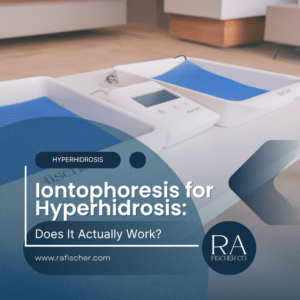
The Fischer: one device for hands, feet and underarms.
| Drionic | The Fischer | |
|---|---|---|
| Power | Battery powered | Mains powered, consistent current |
| Areas per device | One. Separate units for hands, feet and underarms | One device covers all three |
| Hands and feet together | No | Yes, in the same session |
| Session length | 30 to 60 minutes per extremity | 15 to 20 minutes |
| Current control | Thumbwheel | Adjustable 1 to 30 mA with a digital display |
| Current modes | Direct current | Direct and pulsed current |
| Electrodes | Aluminium, which corrodes over time | Metal-free silicon-graphite, no corrosion |
| Running costs | Replacement batteries and electrodes | None. No consumables |
| Warranty | 6 months | 4 years, plus a 60-day guarantee |
| Insurance | Sold direct to the patient | Covered by most major US plans; prior authorization handled for you |
Specifications change. Check Drionic’s current documentation before deciding.
Where Drionic is the better choice
Drionic is the cheapest way into iontophoresis, at roughly $200 a unit. If you sweat in one area only, want to try the treatment without a significant outlay, and are paying out of pocket regardless, that is a reasonable place to start.
Being battery powered also makes it portable, with no socket required. For someone who travels constantly, or treats somewhere without easy power, that matters.
Where The Fischer is the better choice
- Time. One 15 to 20 minute session for hands and feet together, rather than 30 to 60 minutes per area. Over months of treatment this is the difference most patients notice.
- Running costs. No batteries and no electrode replacements. Silicon-graphite electrodes do not corrode and last the life of the device.
- Consistent current. A mains supply delivers steady current throughout the session. Battery output falls as the battery drains, which is why battery devices can feel strong at first and weak by the end.
- Control. Adjustable from 1 to 30 mA with a digital display, rather than a thumbwheel you set by feel.
- Warranty. Four years against six months, plus a 60-day money-back guarantee.
- Insurance. Most major US plans cover The Fischer as durable medical equipment, and we handle prior authorization and claims.
The cost over time
Drionic looks considerably cheaper, and on day one it is. The picture changes once you account for how it is actually used.
- One unit per area. Treating hands and feet means buying two.
- Batteries are proprietary and consumable. Each one covers a limited number of sessions, so the cost recurs for as long as you treat.
- Aluminium electrodes corrode and need replacing, which is a further recurring cost.
The Fischer is a one-time purchase with no consumables. And for insured US patients the comparison often collapses entirely: plans including Tricare, Aetna, Cigna, United Healthcare, Horizon BCBS and Select Health commonly cover it when a provider documents medical necessity. Many patients pay nothing out of pocket, which makes a sticker-price comparison beside the point.
Frequently asked questions
Is Drionic or The Fischer better for sweaty hands and feet?
The Fischer, if you sweat in both areas. It treats hands and feet together in one 15 to 20 minute session, while Drionic treats one area at a time in sessions of 30 to 60 minutes and requires a separate unit for each area.
Why does battery power matter?
Current output falls as a battery drains, so the dose you receive at the end of a session may be lower than at the start. A mains-powered device holds a steady current throughout. Batteries are also a recurring cost for as long as you treat.
Do aluminium electrodes cause problems?
Metal electrodes corrode with repeated exposure to water and current, which degrades performance and means replacing them periodically. The Fischer uses metal-free silicon-graphite electrodes, which do not corrode and last the life of the device.
Is Drionic covered by insurance?
Drionic is sold directly to patients. The Fischer is covered by most major US insurance plans as durable medical equipment for hyperhidrosis, and RA Fischer submits prior authorization and claims. For an insured US patient this is usually the biggest difference in what you actually pay.
Can I try The Fischer and return it?
Yes. The Fischer includes a 60-day money-back guarantee on eligible US orders and a 4-year limited warranty. Call (800) 525-3467 for a Return Authorization before shipping anything back.
Still deciding?
Our Treatment Specialists talk people through this comparison every day, including people who end up choosing something else. There is no obligation, and we can tell you what your insurance covers before anything is ordered. Call (800) 525-3467 or send us a message.
Read next: how The Fischer works, or compare it with miraDry, Dermadry and Hidrex.